Showing posts with label Basic Principles. Show all posts

Thursday, February 12, 2009

Significance of the Eclipse in Astrology

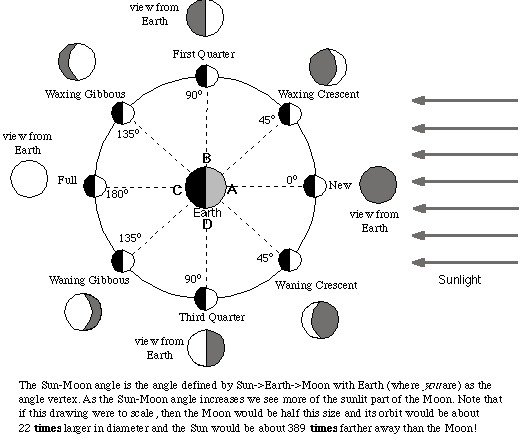
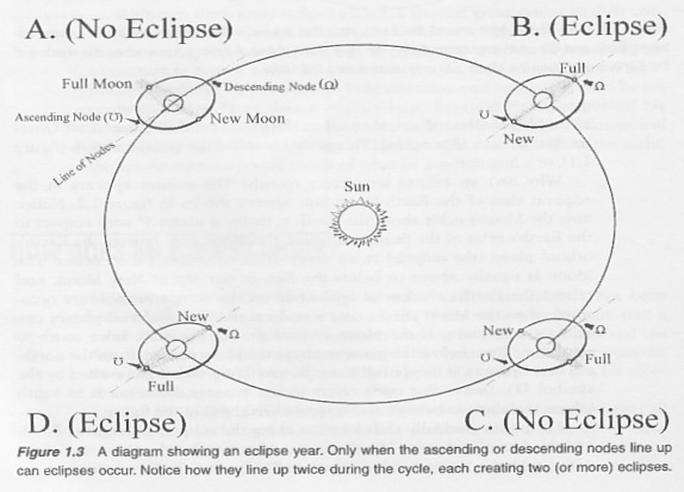
In understanding the astrological significance of the eclipse phenomenon it is easier if we refer back to the traditional astronomical perspective. An eclipse is a temporary loss of light. This definition itself is insightful as we work with symbolism because we know that the light referred to here is associated with the Sun, which is the symbol of our life and life-path. The dark is the shadow associated with Pluto. Taking it from here it will not be difficult to see the implication of the definition at different levels in our lives. The diagram below shows a lunar eclipse as a temporary-loss-of-light concept.


An eclipse is a special kind of transit, because the Sun and Moon are conjoined they both transit a natal planet. Eclipses always accompany the Moon's nodes. Solar eclipses are new moons. They trigger events or flush out unresolved issues. Lunar eclipses are full moons. They have a strong emotional "breaking out" feeling to them.

A "New Moon" is a conjunction of Sun and Moon. This means Sun and Moon would be visualised together from the Earth's perspective. In reality, we cannot see them because the Sun is so bright that the Moon cannot be seen in the daytime. A "Full Moon" is an opposition of the Sun and Moon. That means, simplistically, that we on Earth, have the Sun on one side of us and the Moon on the other. At night we can see the light of the Sun fully reflected off the Moon. Astrologically, the Full Moon is likely to represent a point of balance and a sense of completion or fulfillment.
An eclipse appears most astrologically significant when it either conjoins or opposes a natal planet, but other aspects may also have an effect, albeit a weaker one.The more precisely a Solar or a Lunar eclipse aspects a planet in someone's birth chart, the more "life challenging" the event may be in his life. When an eclipse transits a natal planet or angle, it puts that planet or angle into a high-energy state in which its capacity to generate action is increased and act as a catalyst for change in that area. For instance when an eclipse conjuncts the 1st/7th house axis, it may impact on a relationship, or when it aligns with the 4th/10th house axis, the individual may find that he needs to make adjustments to balance his career with his family life.

Eclipses are often said to be difficult, but that is not necessarily so. The difficulty of the eclipse depends more upon the condition of the natal planet as indicated by house position and aspects to it from other natal planets. Eclipses are generally feared by ancient man, for obvious reasons. They perceive the lights in the sky as "Gods", and if a familiar light was suddenly dimmed, they consider the portent as evil. Since life was a great deal less certain then, it is easy to imagine that a subsequent disaster might occur that could then be connected with the preceding eclipse. Hence, interpreting an eclipse negatively is a carryover from ancient thought, but times have changed drastically since.

Once either a solar or a lunar eclipse hits a key point in a person's birth chart, he may experience a major change 3, 6, 9 or 12 months later. These three-month periods are associated with the New or Full Moons that either square or oppose original Lunar and Solar eclipse degrees. Quite often Lunar eclipses stimulate change or crisis within 3-6 months after they occur, but the effects fo the Solar eclipses seem to have a longer term effect.

It is difficult to predict just how long an eclipse theme will be dominant in one's life. It depends a lot on how closely it aspects a significant planet in his natal chart. Most major events in life can be related to the previous eclipse, yet other eclipses, where no close aspects are made in the chart, may not relate to anything noticeably significant in one's life.

An eclipse may also time a significant event in a country. For example in the recent Australian bush fire which started on 7th Feb and in which more than a hundred lives were lost and at least 750 homes destroyed, there seems to be good correlation with a Full Moon eclipse. The eclipse became exact at 11:46 pm at Melbourne time on 9th February and it was in an exact square with the position of the Moon in the Australian National Chart (cast for 1st Jan 1901, 1:25 pm). The Moon is the ruler of the 4th house and this suggests a significant loss of the country's innermost security and home image in its history of bush fires.

Tuesday, February 10, 2009

Anatomy of the Birth Chart

Introduction

A client is seriously considering a change of company and finds himself at the cross-roads. Feeling that he has reached the stage when he needs vocational guidance from someone else, he walks into an astrologer’s office for the first time and produces his birth data. Using the date, time, and the client’s birthplace the astrologer swiftly casts a birth chart, dwells on it visually for a few moments and starts verbalizing the client’s personality traits with astounding accuracy.

We hear such stories not infrequently. Often we are bewildered by the perceived mysticism that shrouds the story, occasionally wondering if the astrologer possesses psychic ability, or if he doesn’t, whether he seeks supernatural help? Perhaps not, our rational mind tells us. We then start urging ourselves to examine natural, plausible explanations first.

In this article, we take a pragmatic approach to the issue, beginning with an anatomical dissection of the birth chart (Fig. 1), and hopefully make sense out of it.


Anatomy of the Natal Chart

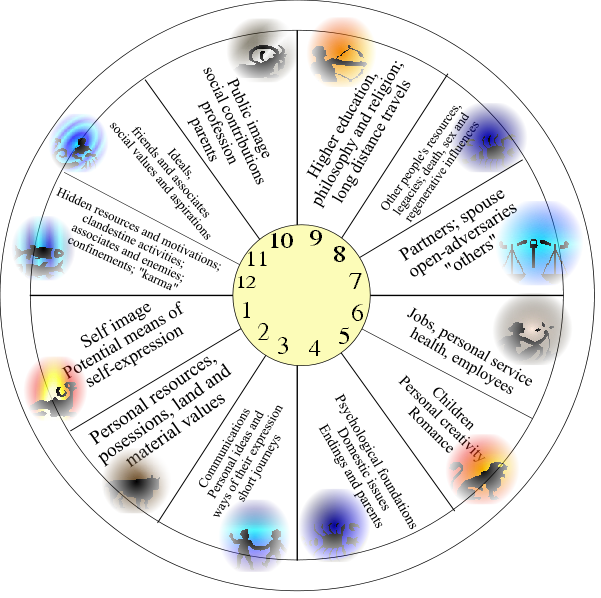
The first breath of life is very dear to all of us born into the world for it marks the start of our life’s journey. Early man did not have the benefit of the clock. So he developed a way of capturing this important symbolic moment by noting and charting the positions of the moving planets in the heavens. He divided the 360 degrees of the celestial sphere into twelve 30-degree segments, better known as “zodiac signs” to facilitate mapping. Each sign symbolizes a mini-culture with unique ways of relating, sharing and getting things done. Likewise, the terrestrial sphere was also divided into twelve “houses” representing life’s basic existential arena.

The concept of astrological houses is generally less well known than the zodiac. Briefly, a “house” symbolizes an area of human activity or territory we can enter and explore. For example, there is a “house of resources” (2nd), a “house of partnership” (7th) and a “house of career” (10th), etc. Some houses represent internal rather than external territories, such as the “house of secrets” (12th). The key is to know that all houses are concrete areas of life where we can make choices.

The birth chart or “natal horoscope” is really a snapshot of the planetary positions of the sky at the moment of birth. The planets are represented as glyphs on a circular scale and plotted against a particular sign and house. The chart structure, though complex at first glance, may be conceptualized as three superimposing wheels, each highlighting either the planets (including Sun and Moon), the signs or the houses (Fig 2). Together they constitute a powerful code of our inner psyche. An easy way to understand horoscope dynamics is to perceive each planet as an actor playing a role specified by the zodiac sign and acting out the life script determined by the house it is placed. Just imagine that a psychodrama is going on among the “actors” of the horoscope. The angular relationships between planetary positions will manifest as psychological forces within the individual’s psyche.


Mechanics of Interpretation

The unit of analysis in astrology is the composite of planet+sign+house. The key to chart interpretation is combining their symbolism creatively to unleash their diagnostic power.

We shall use the birth chart in Fig.1 as an example. It is cast for 5:15 pm, 7th Oct 1927, the birth date and time of Dr. Ronald D. Laing (1927-1989), a famous Glasgow-born psychiatrist. He practiced psychotherapy innovatively according to his understanding of phenomenology. His literal works and biography are probably familiar to students in Psychology.

At the time of Laing’s birth, Mars is in Libra and the 7th house. Being the warrior god in Greek mythology, Mars symbolizes assertiveness, aggression and desire. Libra, represented by the Scales, is symbolic of harmony, relationship and balance. The 7th House means partnerships. Merging the symbolism together gives us composite meanings like: aggressive romantic partner, impulsive marriage, problematic marital relationships, or a mix of all three (Fig.3).


Sun in Libra

Most people are familiar with Sun sign meanings nowadays. At least they probably know enough to say “I am an Aries” or “I am a Scorpio”. Others who have browsed pop-astrology books may be able to interpret “Libra” as “relationship, balance, diplomacy and, harmony”. The more intuitive readers may even come forth with a statement like: “Sun in Libra makes Dr. Laing an affectionate, well balanced person with a charisma that attracts friends”. This interpretation is indeed correct. Laing’s Sun resides in Libra and the 7th house of partnership and Mars is only 4o away from Sun. Given this proximity, his romantic affection becomes strongly flavoured with “war-like” qualities of Mars. We shall verify this with his biography.

Laing began his marital life with a shotgun wedding with Nurse Anne Hearne in 1952, but broke up when he had an affair first with journalist Sally Vincent in 1962 and later with Jutta Werner in 1965, He married Jutta in 1974, but went on to father a child with Sue Sunkel in 1984. He divorced Jutta in 1986 and thereafter spent the rest of his life with his personal assistant Marguerita Romayne. Such an eventful romantic life is indeed consistent with the combined Sun-Mars symbolism.

Moon in Aquarius

The Moon is filled with feelings and intuition, whereas Aquarius is reputed to have the archetypes of the genius or the revolutionary. In the 11th house of Hopes and Wishes, Laing tended towards original thinking, defying traditional thought. However, his Aquarius Moon blends well with the harmony of the Libran Sun inclining him towards idealism and abstract thought. Sadly throughout his career, he was labeled as a misfit with the establishment.

Rising Sign of Pisces

Pisces was rising above the horizon at the time of birth. Being an inherently dreamy sign, Pisces symbolized the way Laing viewed himself and the world. It gave him an idealistic identity, increased his sensitivity to feelings and filled him with vision. These characteristics were tinted by the disruptive and unpredictable energies of Uranus lurking just beneath the horizon. In addition, Jupiter located just above the horizon expanded all the afore-mentioned tendencies.

As a psychiatrist, Laing was renown for the personal crusade that he embarked in the 1960’s to reframe the prevailing concept of “madness”. He challenged the psychoanalytic movement at that time and persuaded his peers to adopt his ideas on the science of interpersonal phenomenology. He put his theory into practice in his Kingsley Hall experiment whereby mental patients and their therapists stayed and lived together under one roof. In return he was criticized by his peers as “anti-psychiatry” and deregistered by the British Medical Council.


Author: Peter Mack
(This posting is adapted from the articles written by the author in the Jan and Feb issues of DAWN magazine)